Veterinary Patient Whiteboards: How to Track Hospitalized Patients in Real Time
A veterinary patient whiteboard gives the clinical team a shared view of hospitalized patients, their current status, planned treatments and pending tasks. By making essential workflow information easier to see and update, it can support daily rounds, clarify task ownership and improve shift handovers. It should complement—not replace—the formal medical record.
When several patients are hospitalized at the same time, keeping everyone informed becomes a clinical and operational challenge. One patient may be recovering from surgery, another may be waiting for diagnostic results, while a third requires scheduled medication, reassessment or close observation. Each patient has a different care plan, and multiple team members may be involved throughout the day.
When updates are scattered across paper notes, cage cards, verbal messages and individual worklists, it can be difficult to see the complete inpatient picture. A treatment may be planned but not yet completed. A test result may need follow-up. A patient’s condition may have changed since the previous shift.
A veterinary patient whiteboard helps bring essential inpatient workflow information into one visible place. Whether a clinic uses a physical board or a digital dashboard, the objective is the same: help the team understand which patients are hospitalized, what needs attention and who is responsible for the next action.
For medical directors, hospital managers and veterinary technicians, an effective whiteboard is more than a patient list. It is a practical coordination tool that supports a clearer, more consistent inpatient workflow.
What Is a Veterinary Patient Whiteboard?
A veterinary patient whiteboard is a centralized display used to track hospitalized patients and communicate important operational updates to the veterinary team. It provides a quick overview of each patient's current status, treatment progress and pending care activities.
A physical veterinary treatment whiteboard may use columns, labels, magnets or colour-coded sections to organize patients. A digital version can provide a shared dashboard that teams can update as patient information and workflow priorities change.
A typical patient status board in a veterinary clinic may help staff identify:
Which patients are currently hospitalized.
Their current care or recovery status.
Treatments or procedures that are planned or in progress.
Tasks awaiting completion.
Follow-ups that need attention.
The team member responsible for an assigned task.
The purpose is not to display every clinical detail. It is to give authorized team members a practical overview of inpatient activity without requiring them to search through multiple communication channels.
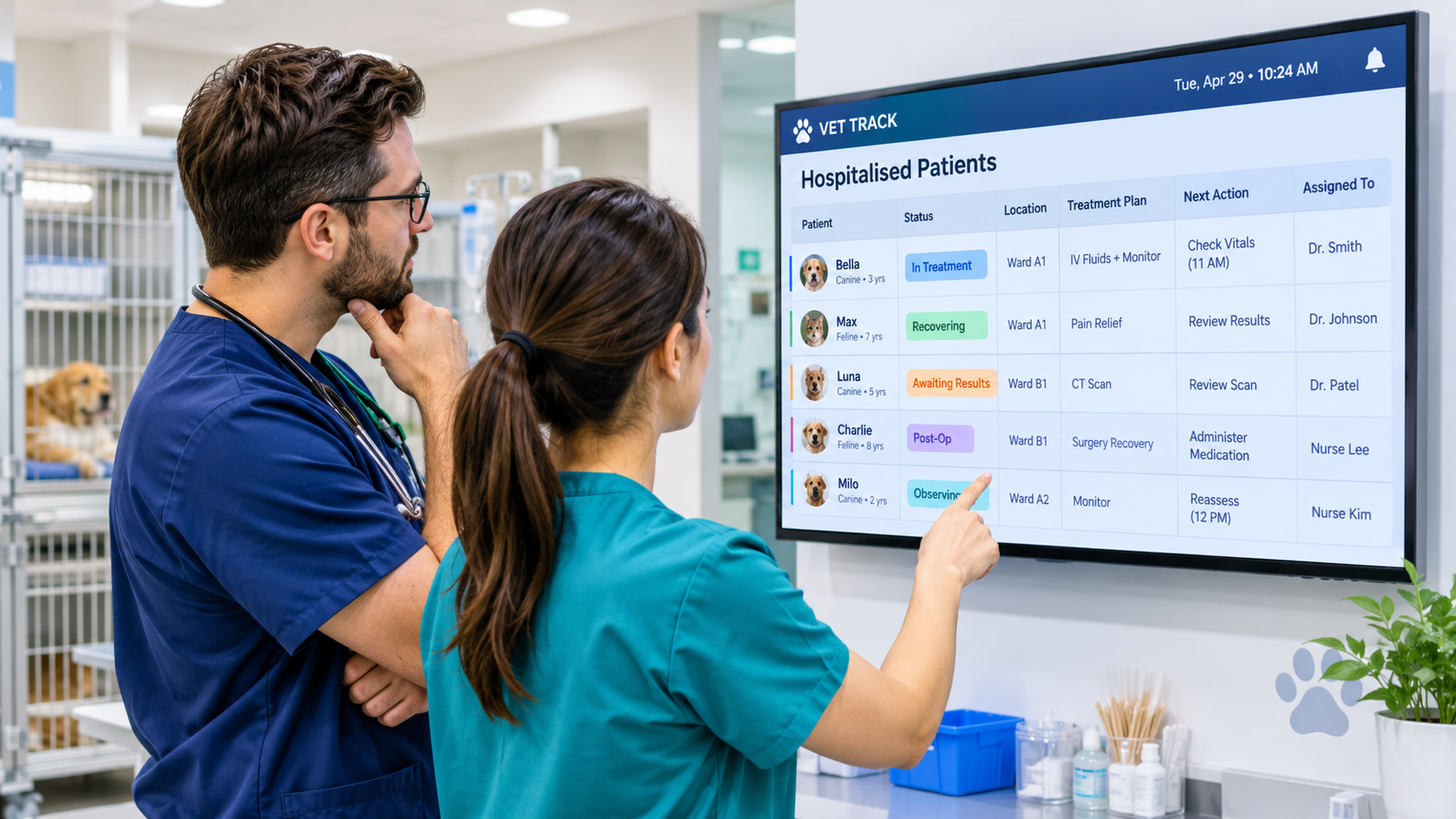
Woovet's VET TRACK Whiteboard is designed for this purpose. It provides a real-time dashboard to monitor hospitalized patients, track status and treatment progress, coordinate team updates and support shift handovers. Its customizable format allows clinics to align the whiteboard with their own workflow and priorities.
What Information Belongs on an Inpatient Status Board?
An effective inpatient board should make essential information easy to find without becoming cluttered. The exact layout will depend on the hospital's services, patient volume, staffing model and clinical protocols.
Useful information categories can include:
1. Patient identification: Use the patient's name, a unique patient identifier and the relevant location or ward. Include enough information to prevent confusion between patients with similar names. Follow the clinic's privacy and identification policies.
2. Current status: Use clear, standardized labels to indicate the patient's workflow stage—for example, admitted, awaiting assessment, in treatment, recovering, awaiting results or ready for discharge. Define each status so that different team members interpret it consistently.
3. Planned treatments and procedures: Show the next relevant treatment, procedure or reassessment that the team needs to coordinate. Detailed instructions, medication doses and clinical parameters should remain in the appropriate medical record or approved clinical system.
4. Pending tasks: Highlight actions that still need attention, such as collecting a sample, reviewing a diagnostic result, completing a scheduled care activity or contacting the veterinarian.
5. Task ownership: Make the responsible team member or role visible where appropriate. An assigned task is easier to follow up than a task that simply appears on a shared list.
6. Important workflow notes: Where appropriate, include a brief operational reminder, such as a pending client update or a discharge-planning step. Avoid placing unnecessary confidential or sensitive information on a display that may be visible to people who do not need access.
The guiding principle is simple: display information that helps the team coordinate the next step. Keep detailed clinical documentation in the patient's formal record.
How Should Teams Distinguish a Status Board from the Medical Record?
A whiteboard and a medical record serve different purposes. Confusing the two can create documentation and continuity problems.
The whiteboard is a workflow overview. It helps the team see what is happening across hospitalized patients, what is pending and which tasks need attention.
The medical record is the clinical source of truth. It contains the detailed patient history, examination findings, assessment, treatment plan, medication instructions, monitoring observations, diagnostic results, clinical decisions and relevant communications.
For example, a status board might show that a patient is scheduled for a reassessment or that a diagnostic result is awaiting review. The medical record should contain the relevant clinical findings, decisions, instructions and completed documentation.
This distinction is important for accountability. The Veterinary Practitioners Registration Board of Victoria's reflections on case handover highlights the need for clinical records that allow another practitioner to continue care. It also cautions against relying on information recorded only on cage cards that are not retained by the clinic.
A useful rule for every inpatient team is: the board communicates the workflow; the medical record documents the care. Any clinically important information first noted on a temporary board, cage card or other informal aid should be transferred to the appropriate record according to clinic policy.
How Can Whiteboards Support Rounds and Treatment Ownership?
Rounds are an opportunity for veterinarians and inpatient-care teams to review patients, evaluate progress and coordinate the next steps. A well-maintained veterinary patient whiteboard can make these discussions more structured.
Instead of building the patient list from separate notes or relying on memory, the team can review a shared overview and work through each hospitalized patient.
During rounds, teams can use the board to:
Confirm each patient's current status.
Review the next planned treatment or reassessment.
Identify tasks that remain incomplete.
Clarify who is responsible for each action.
Highlight cases that require a veterinarian's review or a change in plan.
Identify patients approaching discharge or requiring further planning.
Task ownership is particularly important. If a treatment or follow-up is listed without a responsible person or role, it can become unclear who should complete it. Assigning ownership and defining how completion is recorded makes the workflow easier to follow.
The board should support clinical discussion rather than determine clinical decisions. Changes in a patient's condition, treatment plan or monitoring requirements must be assessed and documented by the appropriate veterinary professional.
How Should Patient Status and Pending Tasks Be Updated?
A whiteboard is only useful when the information displayed reflects the current workflow. An outdated board can create the same confusion as having no shared board at all.
Clinics should establish a consistent update process and make it part of routine inpatient responsibilities.
A practical approach includes:
- Update at admission: Add the patient to the board when the hospitalization workflow begins. Confirm identification, location, initial status and the relevant next steps.
- Update when the plan changes: When a veterinarian changes the care plan or a patient's status, ensure the appropriate clinical record is updated and the corresponding workflow information is revised.
- Update after task completion: Mark tasks complete using a standardized process. Avoid leaving completed treatments or pending actions displayed as though they are still outstanding.
- Review during rounds: Use rounds to identify missing updates, unclear ownership and tasks that need to be reprioritized.
- Review before shift change: Confirm that the board reflects the latest known workflow status and that outstanding tasks are visible to the incoming team.
- Check at discharge or transfer: Remove or update the patient's active inpatient status according to clinic procedure, while retaining the required clinical documentation.
For clinics using a digital dashboard, the team should understand how updates are made, who can make them and whether changes are visible to other authorized users. A digital display should not be assumed to update automatically unless the system specifically supports that functionality.
What Makes Shift Handovers Safer and Clearer?
A hospitalized patient may receive care from several veterinarians and technicians across multiple shifts. A clear handover helps the incoming team understand what has happened, what has changed and what still needs attention.
The Veterinary Practitioners Registration Board of Victoria recommends verbal handover or rounds for patients receiving ongoing care. It also emphasizes that verbal updates should be supported by the clinical record, which must contain enough information for another practitioner to continue care.
A veterinary patient whiteboard can support this process by giving the team a shared overview during handover. For each patient, the outgoing and incoming teams can review:
- Current status and any relevant change since the previous shift.
- Treatments and workflow tasks completed.
- Outstanding actions and their assigned owners.
- Pending diagnostics or results requiring review.
- Planned reassessments and follow-up steps.
- Relevant client communication or consent matters that need to be followed up.
The board should not be the only handover resource. The incoming team must also review the patient's medical record and receive the necessary clinical context from the outgoing team.
For patients undergoing sedation or anesthesia, the ACVAA 2025 Small Animal Anesthesia and Sedation Monitoring Guidelines provide recommendations on monitoring, personnel and record keeping during the relevant periods. A status board may help remind a team about workflow responsibilities, but it cannot replace required patient observations, monitoring records or clinician-led assessment.
Digital vs. Physical Whiteboards: What Should Clinics Consider?
Both physical and digital whiteboards can help organize veterinary inpatient tracking. The right option depends on how the clinic operates, how frequently information changes and how many people need access to the board.
Physical whiteboards are familiar, easy to view in a shared clinical area and often simple to set up. However, they depend on manual updates, may become crowded as patient numbers increase and can be difficult to keep consistent across different locations or shifts. Clinics must also consider who can see the information and how it is cleared or retained.
Digital whiteboards can offer a centralized view, more flexible layouts and updates that are visible to authorized team members. They may be easier to customize as inpatient workflows evolve. Their effectiveness depends on usability, access controls, staff adoption and the accuracy of the information entered.
When evaluating a digital veterinary treatment whiteboard, consider:
- Can the team see all hospitalized patients from one dashboard?
- Can patient status and treatment progress be updated easily?
- Can the layout be adapted to the hospital's workflow?
- Can team members identify pending actions and responsibilities?
- Does the system support live updates and shift handovers?
- Are access, privacy and information-retention requirements addressed?
- Can the team use it consistently during busy periods?
Woovet's VET TRACK Whiteboard is designed to help clinics monitor hospitalized patients through a real-time dashboard. It supports patient-status and treatment-progress tracking, live team updates, shift handovers and workflow customization.
Clinics comparing options can also review Woovet's guide to choosing veterinary practice management software to consider how inpatient tracking fits into their broader practice-management needs.
How Can Clinics Measure Adoption and Visibility?
Introducing a whiteboard does not automatically improve an inpatient workflow. Teams need to use it consistently, update it accurately and understand how it fits into existing clinical processes.
Medical directors and hospital managers can evaluate adoption through practical operational checks.
- Update consistency: Are patient statuses and pending tasks being updated when the workflow changes?
- Task visibility: Can team members identify which actions remain outstanding and who is responsible for them?
- Handover quality: Do incoming staff use the board alongside the medical record and verbal handover?
- Workflow clarity: Can team members quickly understand the inpatient list without repeatedly asking for basic status updates?
- Staff adoption: Are veterinarians, technicians and support staff using the same status definitions and update procedures?
- Information accuracy: Are outdated entries corrected, completed tasks cleared and important clinical details documented in the appropriate patient record?
A short review with the inpatient team can reveal whether the board is genuinely helping. Ask staff which information they use most, which updates are frequently missed and where the layout creates confusion. Use that feedback to refine the board and team procedures.
The objective is not to measure how much information the board contains. It is to determine whether the team can find the right operational information, understand the next action and coordinate care more clearly.
Conclusion
Hospitalized-patient care involves more than keeping a list of admitted animals. It requires a coordinated view of patient status, treatment progress, pending tasks and team responsibilities. A well-designed veterinary patient whiteboard helps make that information easier to access during rounds, daily care and shift handovers.
The most effective approach combines a clear status board, consistent update procedures, defined task ownership and complete clinical documentation. Whether a clinic uses a physical board or a digital dashboard, the system should support—not replace—the clinical judgement and records that guide patient care.
See how Woovet VET TRACK can give your team a clearer view of hospitalized patients. Explore the VET TRACK Whiteboard and discover how a shared, customizable inpatient dashboard can support your clinic's workflow.
Frequently Asked Questions
What is a veterinary patient whiteboard used for?
What should a veterinary inpatient tracking board include?
Can a veterinary whiteboard replace patient medical records?
Are digital veterinary patient whiteboards better than physical boards?
How does a digital patient status board support shift handovers?
Join the hundreds of vets already using Woovet to cut admin time and focus on what really matters.